



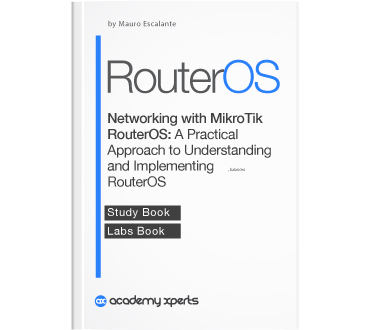
The content of these books
(Study and Labs books)
is entirely in English.
(Book) Networking with MikroTik RouterOS: A Practical Approach to Understanding and Implementing RouterOS
Study material for the MTCNA Certification Course, updated to RouterOS v7
$19,97
Price in US Dollars (USD)
For your convenience, depending on your country, you can contact us via the following WhatsApp numbers:
-
[ Melany ]
+593 99 547 6462 - Argentina
- Chile
- Cuba
- El Salvador
- España
- Perú
- República Dominicana
- EUROPA / AFRICA
-
[ Michelle ]
+593-99-992-9609 - Brasil
- Bolivia
- Honduras
- México
- Nicaragua
- Panamá
- Puerto Rico
-
[ Yomy ]
+593-98-387-6224 - Colombia
- Costa Rica
- Ecuador
- Guatemala
- Paraguay
- Uruguay
- Venezuela
For corporate or large-scale projects, you can reach us at:
(Book) Networking with MikroTik RouterOS: A Practical Approach to Understanding and Implementing RouterOS
Learning Objectives
This book aims to provide readers with a solid foundation in MikroTik’s RouterOS platform and the basic configuration of its devices.
The primary focus is to teach readers how to configure and manage MikroTik devices in small and medium-sized networks, while familiarizing them with its features, tools, and best practices.
Additionally, the book prepares readers for the MTCNA (MikroTik Certified Network Associate) certification exam, validating their skills and knowledge in the RouterOS platform.
Chapter 1: Introduction to RouterOS
MikroTik’s RouterOS platform is introduced in this chapter, offering an overview of its architecture, product versions, and naming conventions.
Topics include accessing MikroTik routers, performing basic configurations, updating firmware, managing users and services, creating backups, and installing RouterOS licenses. The chapter ensures readers gain foundational knowledge to navigate and utilize RouterOS effectively.
Chapter 2: Static Routing
Delving into the fundamentals of static routing, this chapter explains bogon IPs, network metrics, routing tables, and best path selection.
It provides clear instructions for configuring and managing static routes to maintain reliable and efficient connectivity across networks.
Chapter 3: Bridge
Readers will explore Layer 2 networking concepts, focusing on the physical and data link layers, MAC addresses, IP addressing, and address classification. Additionally, the chapter clarifies the distinctions between IPv4 and IPv6 to support effective communication within network environments.
Chapter 4: Wireless (802.11)
Wireless networking concepts are detailed here, including IEEE 802.11 standards, frequency bands, channel configurations, data rates, and modulations. The chapter also discusses MAC filtering, wireless monitoring tools, and bridge-mode setups to enhance network performance and security.
Chapter 5: Network Management
In this chapter, essential network management tools and protocols, such as ARP, RARP, and DHCP operations, are explained in depth. Practical exercises and review questions reinforce the application of these tools in real-world network environments.
Chapter 6: Firewall
Firewall configuration is the focus of this section, with topics including packet flows, protocol mapping, and Connection Tracking. Readers will also learn how to use NAT, filtering rules, and address lists to secure both routers and network clients against potential threats.
Chapter 7: Simple Queues and QoS
This section introduces traffic shaping and Quality of Service (QoS) concepts, with a focus on speed limitation and flow management. Readers will explore the implementation of PCQ, Simple Queues, and other queue types introduced in RouterOS v7, alongside advanced features like Interface Queue and Burst.
Chapter 8: PPP Tunnels
Secure tunneling with PPP is covered in this chapter, explaining how to configure profiles, secrets, and clients in RouterOS. Comprehensive guides for implementing PPPoE, IPIP, EoIP, PPTP, L2TP, SSTP, and OpenVPN tunnels ensure robust and efficient inter-network connections.
Chapter 9: RouterOS Tools
An array of RouterOS tools is introduced here, including Netwatch, Traceroute, Profile, and Torch, to streamline network monitoring and troubleshooting. Advanced utilities like bandwidth testing, packet sniffing, and traffic generators are also covered to enhance network management capabilities.
Además, expone herramientas como prueba de ancho de banda, SMS, Packet Sniffer, IP-Scan, Telnet, SSH, MAC Telnet, Sigwatch, Wake on Lan, Fetch, Dynamic DNS, Flood Ping, Traffic Generator y Monitor de Tráfico de Interfaz.
Upon Completion
By the end of this book, readers will have gained an in-depth understanding of MikroTik’s RouterOS platform. They will be equipped with the knowledge and skills needed to configure, manage, and optimize MikroTik devices in small and medium-sized networks.
Participants will also be prepared to take the MTCNA certification exam with confidence. This certification demonstrates proficiency in RouterOS and positions them as qualified professionals in networking and MikroTik device management.
Furthermore, readers will be empowered to tackle networking challenges and contribute to the growth and efficiency of their organizations by leveraging MikroTik’s technology effectively.
Ultimately, this book provides a comprehensive learning experience that ensures participants are ready to apply what they’ve learned in real-world scenarios, strengthening their professional expertise and advancing their careers.
Includes
- Study Guide + Lab Manual
- Chapter-specific preparation quizzes
- Permanent access to the training portal
- Access to all future content updates
Prerequisites
- A clear understanding of LAN & WAN networking concepts.
- Foundational knowledge of Wireless (WiFi 802.11).
- Strong proficiency in IP Addressing, Subnetting, and VLSM.
What Do You Need
- Internet connection with at least 1 Mbps
- Preferably a laptop or desktop computer
- A tablet or mobile phone as an alternative
Solo los usuarios registrados que hayan comprado este producto pueden hacer una valoración.
Productos relacionados
-
 Libros MikroTik
Pack 8 libros MikroTik RouterOS
$113,54 Añadir al carritoPaquete promocional de 8 libros MikroTik
-
 Libros MikroTik
Pack 7 libros MikroTik RouterOS
$100,99 Añadir al carritoPaquete promocional de 7 libros MikroTik
-
 Libros MikroTik
Pack 5 libros MikroTik RouterOS
$79,88 Añadir al carritoPaquete promocional de 5 libros MikroTik
-
 Libros MikroTik
Libro Conceptos Fundamentales de MikroTik, RouterOS v7
$19,97 Añadir al carritoMaterial de estudio para el Curso de Certificación MTCNA, actualizado a RouterOS v7



Valoraciones
No hay valoraciones aún.